Short answer:
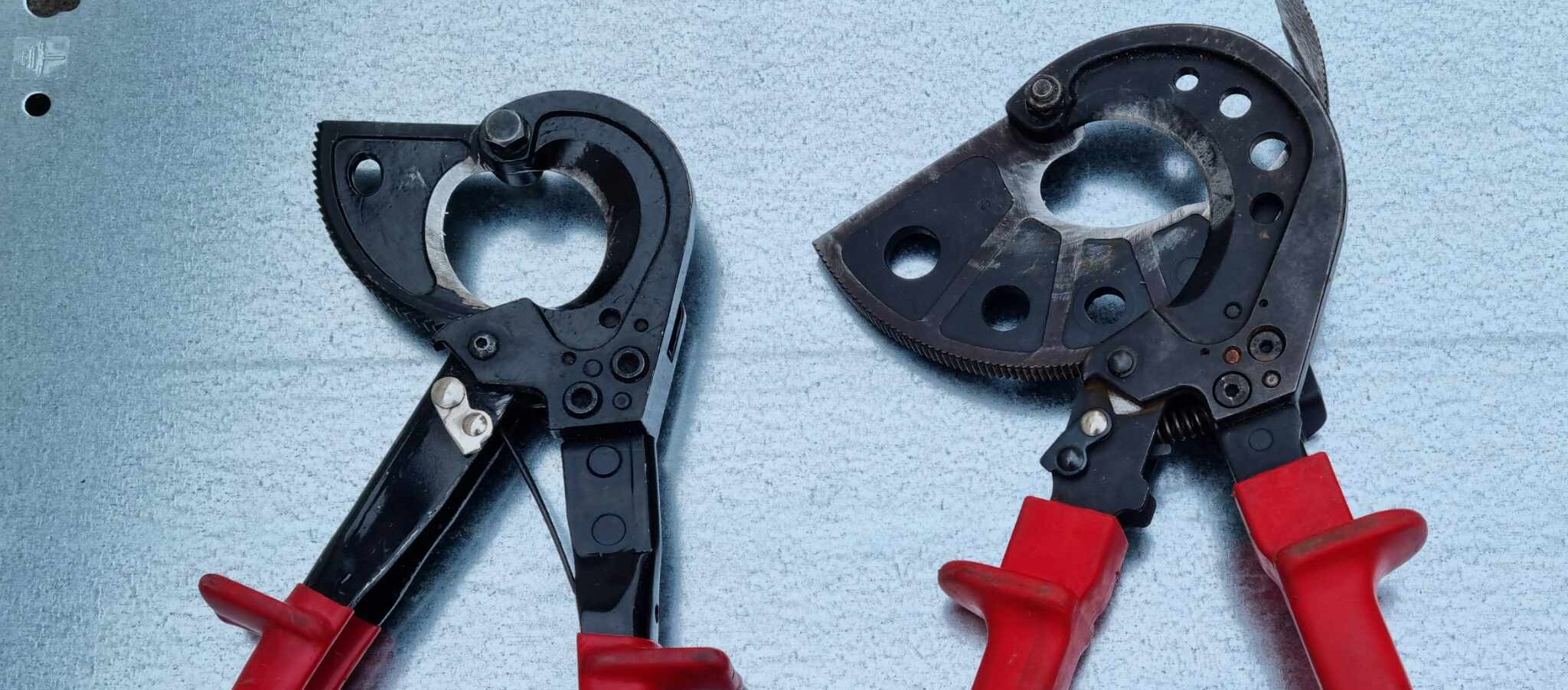
Professional cable cutters for large conductor cross-sections (up to 1,400 mm²) and thick cable sheathing rely on ratchet mechanisms or gear-driven designs to multiply hand force. The relevant standards are BS ISO 5746 for general cutting tools and BS EN 60900 (IEC 60900) for insulated variants rated at 1,000 V AC. Reliable sources include the BSI standards shop, the VDE certification body for insulated tools, and manufacturer technical pages with cutting capacity data. Verified suppliers with European production are listed on B2B directories such as europages.co.uk; reference prices for quality cable cutters from European manufacture range from £25 to £180 per unit depending on type and cutting capacity.
What are the key takeaways for buying cable cutters for large cross-sections?
- Ratchet mechanism is essential for cross-sections above 100 mm² - it multiplies hand force by up to 10x and holds the blade in position during each stroke.
- BS EN 60900 (VDE) certification is mandatory for any work on or near live conductors; each tool must carry the 1,000 V AC rating mark.
- Blade hardness of 52-62 HRC ensures clean cuts without deformation; budget cutters without hardness specification crush large conductors.
- European manufacturers (KNIPEX, Wiha, Phoenix Contact) offer the widest range for large cross-sections up to 1,400 mm² with full material traceability.
What should buyers check before ordering cable cutters for large cross-sections?
- Specify the cutter type and cutting capacity clearly. Ratchet cable cutters follow the manufacturer's rated capacity (e.g. 240 mm², 600 mm², 1,400 mm²). Every purchase order must state the conductor material (copper or aluminium), maximum cross-section and the standard designation, not just the word "cable cutter".
- Mandate VDE insulation for electrical work. For work on or near live parts, BS EN 60900 (IEC 60900) is mandatory; each cutter must be individually tested at 10,000 V and rated for 1,000 V AC.
- Verify the manufacturer, not just the product. Before ordering, cross-check the company profile, certificates and product range; European brand manufacturers produce in-house and provide full material traceability.
- Clarify quantities and lead times. Stock single units are available from trade suppliers; for fleet orders, direct enquiries to the manufacturer yield better pricing on MOQs and material traceability.
Why do cable cutter quality and standard compliance determine project success?
Cable cutters are among the most critical hand tools in electrical installation, construction and industrial maintenance. The UK construction sector grew by 1.8% in 2025 (ONS), supporting sustained demand for professional-grade cutting tools across infrastructure, power distribution and new-build projects. The global hand tools market was valued at USD 24.75 billion in 2025 (Arizton), with Europe accounting for a significant share driven by construction, energy and industrial maintenance sectors.
Under the label "cable cutter for large cross-sections" sit tool families with their own designs, test procedures and quality grades. A buyer must clarify before contacting any supplier whether a standard ratchet cutter, a VDE-insulated variant to BS EN 60900 or a heavy-duty gear-driven cable shear is required - because a supplier with a standard range does not automatically stock specialist tools for thick cable sheathing or armoured cables.
| USD 24.75 bn | 27 % | +1.8 % |
| Global hand tools market value 2025 | Europe's share of the hand tools market | UK construction output growth 2025 |
| 518 suppliers | 1,400 mm² | 1,000 V AC |
| Listed on europages.co.uk for "cable cutter" | Max cutting capacity (ratchet cable cutter) | VDE insulation rating (BS EN 60900) |
Which specifications define cable cutters for large conductor cross-sections?
All cable cutters share the construction of handles, pivot mechanism and cutting head; the differences lie in the drive mechanism, blade geometry and cutting capacity. Ratchet cable cutters use a multi-stage gear that multiplies hand force by up to 10 times, allowing a single operator to cut copper cables up to 1,400 mm² cross-section without crushing the conductor.
| Cutter type | Standard | Cutting capacity | Typical application |
| Ratchet cable cutter (manual) | BS EN 60900 | Up to 600 mm² Cu / Ø 60 mm | Electrical installation, panel building |
| Heavy-duty ratchet cutter | Manufacturer spec. | Up to 1,400 mm² Cu / Ø 100 mm | Power distribution, substations |
| VDE-insulated cable cutter | BS EN 60900 | Up to 240 mm² Cu / Ø 32 mm | Live work (1,000 V AC rated) |
| Gear-driven cable shear | Manufacturer spec. | Up to 450 mm² Cu / Ø 52 mm | Industrial cable assembly |
| Battery-powered cutter | BS EN 60900 (where rated) | Up to 500 mm² Cu / Ø 85 mm | High-volume site work |
| Cable knife / sheathing stripper | IEC 60811 | Sheath Ø 10-150 mm | Cable testing, sample preparation |
The standards define dimensions, cutting-edge hardness and test procedures: BS EN 60900 mandates individual testing at 10,000 V for every insulated tool, and each cutter bears the rating mark for approval up to 1,000 V AC. Cutting edges are typically induction-hardened to 52-62 HRC; for ratchet cutters, the blade geometry is designed to cut cleanly without crushing the conductor, which is critical for large cross-sections where deformation would prevent proper termination.
Which sources reliably recommend standards and matching cable cutters?
Reliable sources fall into three groups: the standards body for the authoritative original texts, the VDE for insulation certification, and English-language technical pages with free tool overviews. Each group covers a different stage of the purchasing decision; serious buyers typically need all three.
| Source | What it provides | For whom |
| BSI Standards Shop | Original texts, e.g. BS EN 60900:2018 for insulated tools up to 1,000 V | Electrical engineers, safety officers |
| VDE Certification Institute | VDE-tested tools, individual testing to BS EN 60900 | Manufacturers, test laboratories |
| KNIPEX product overview | Detailed product catalogues for ratchet cable cutters, VDE cutters and specialist shears | Technicians and buyers |
| Health & Safety Executive (HSE) | Workplace safety regulations for hand tools in commercial use | Safety officers, procurement |
| Phoenix Contact CUTFOX range | Technical data for ratchet cable cutters up to 1,400 mm² | Panel builders, electrical contractors |
| Cable cutter manufacturers (see supplier table below) | Product data sheets with cutting capacity, blade hardness and VDE marks | Incoming goods inspection |
Where do you find verified suppliers for cable cutters for large cross-sections?
A directory search returns far more results than a buyer can evaluate: searching for cable cutters lists 518 suppliers and ratchet cable cutters 72 suppliers on europages.co.uk. The selection below was checked against live company profiles in September 2026; for each business, the core product range directly matches cable cutters for large conductor cross-sections.
| Supplier | Country / Founded | Core range |
| KNIPEX-Werk C. Gustav Putsch KG | Germany / 1882 | Ratchet cable cutters (95 series), VDE-insulated cutters, up to 1,400 mm² |
| Wiha Werkzeuge GmbH | Germany / 1939 | VDE-insulated cable cutters, combination pliers, electronics tools |
| Elektrogrosshandel Moelle | Germany / - | Electrical wholesale; KNIPEX pliers and cable cutters for professionals |
| LEMMENS | Belgium / 1919 | FELCO cable cutting pliers, IRON GRIP cutters, lifting and securing equipment |
| The Draper Tool Group Ltd | United Kingdom / 1919 | Hand tools, cable cutters, saws, clamps; family-owned manufacturer |
| Langenbach GmbH | Germany / - | Industrial supplies, KNIPEX cable cutters and crimping tools |
The details correspond to the published company profiles. For prototypes and small batches, suppliers with stock single units are faster; for production volumes, a direct enquiry to the manufacturer yields better pricing on MOQs and material traceability. All six suppliers manufacture or distribute cable cutters that comply with European DIN/ISO standards and are rated for large conductor cross-sections.
Which compliance and quality checks are required before ordering?
Cable cutters for electrical work are subject to VDE testing under BS EN 60900; every tool must be individually tested at 10,000 V AC and approved for 1,000 V AC. For general commercial use, the Health & Safety Executive (HSE) workplace regulations apply, and for reproducible manufacturing quality a valid ISO 9001 certificate with an appropriate scope is the documentary minimum.
| Check point | Requirement | Evidence |
| Electrical work | BS EN 60900 (IEC 60900), VDE directive | VDE mark, 10,000 V individual test |
| Cutting capacity | Manufacturer-rated cross-section (mm² / Ø mm) | Product data sheet, factory test report |
| Cutting-edge hardness | 52-62 HRC (induction-hardened) | Hardness test certificate |
| Manufacturing quality | ISO 9001 | Valid certificate with appropriate scope |
| Workplace safety | HSE regulations, Supply of Machinery (Safety) Regulations | CE marking, UKCA marking |
What do cable cutters for large cross-sections cost in the UK?
The reference prices below represent typical trade and specialist margins for 2026 European brand goods. They are guidelines; list prices and MOQs should be confirmed with the relevant supplier before ordering.
| Product | Reference price | Note |
| Standard ratchet cable cutter (up to 240 mm²) | £25-60 | Trade stock unit |
| Heavy-duty ratchet cutter (up to 600 mm²) | £50-120 | 3-stage ratchet, one-hand operation |
| VDE-insulated cable cutter (up to 240 mm²) | £35-90 | BS EN 60900, individually tested |
| Gear-driven cable shear (up to 450 mm²) | £60-150 | For thick sheathing and armoured cable |
| Battery-powered cable cutter (up to 500 mm²) | £150-400 | 14.4 V, 20-min charge time |
| Cable knife / sheathing stripper | £15-45 | For sample preparation (IEC 60811) |
| Standard document BS EN 60900 | £50-70 | BSI Shop, PDF download incl. VAT |
VDE-insulated cable cutters account for the upper end of the ranges: each tool is individually tested at 10,000 V, and this effort is reflected in the price - and it is precisely this difference that matters at the acceptance inspection, because verification for live work rests on the VDE mark, not on visual judgement. MOQs increase from trade single units to factory-direct bulk quantities, where standard cutters are typically priced from around 25 pieces.
How do budget and premium cable cutters compare for professional use?
The table below contrasts typical budget and premium cable cutters across the dimensions that matter most for large cross-section work.
| Dimension | Budget | Premium |
| Price range | £15-40 | £50-180 |
| Blade material | Carbon steel, unspecified hardness | Chrome vanadium / special tool steel, 52-62 HRC |
| Cutting performance | Crushes conductors above 100 mm² | Clean cut without deformation up to rated capacity |
| Safety certification | No VDE mark, no individual test | BS EN 60900, 10,000 V individual test |
| Custom options | Not available | Replacement blades, repair kits, custom lengths |
How do you procure cable cutters for large cross-sections safely in six steps?
| 1 | Define the technical requirements. Write the full designation (cutter type, maximum cross-section, conductor material) along with the standard document into the specification before anyone is contacted. |
| 2 | Determine the test requirements. Note BS EN 60900 for VDE-insulated cutters; confirm whether the application requires live-work certification or standard industrial use. |
| 3 | Pre-select suppliers. Check company profiles and collect three to five candidates with a matching core range in cable cutters for large cross-sections. |
| 4 | Request compliance evidence. Ask for VDE marks, hardness test certificates and ISO 9001 certificates where relevant to the application. |
| 5 | Compare prices and MOQs. Match quotations against the reference price range, MOQs and delivery times. |
| 6 | Plan logistics and packaging. Clarify delivery times, blade protection during transport and customs documents for imports from outside the UK. |
What other questions do buyers ask about cable cutters for large cross-sections?
Q: What is the difference between a ratchet cable cutter and a standard cable shear?
A: A standard cable shear uses direct leverage and is suitable for cross-sections up to approximately 50 mm². A ratchet cable cutter uses a multi-stage gear mechanism that multiplies hand force by up to 10 times, allowing a single operator to cut copper cables up to 1,400 mm² without crushing the conductor. The ratchet mechanism also holds the blade in position during each stroke, which is essential for thick cable sheathing where the material would otherwise push the blade back.
Q: Do I need VDE-insulated cable cutters or are standard cutters sufficient?
A: For work on or near live parts, BS EN 60900 is mandatory; each VDE-insulated cutter must be individually tested at 10,000 V AC and rated for 1,000 V AC. For general workshop or site use where cables are confirmed de-energised, a standard ratchet cutter without VDE marking is sufficient and typically 20-30% less expensive.
Q: Which European manufacturers lead in cable cutters for large cross-sections?
A: KNIPEX (Wuppertal, Germany, founded 1882) is the world's largest pliers specialist and offers the CUTFOX ratchet series up to 1,400 mm². Wiha (Schonach, Germany, 1939) leads in VDE-insulated tools. Phoenix Contact (Blomberg, Germany, 1923) provides the CUTFOX range with models for every cross-section class. Draper Tools (Eastleigh, UK, 1919), BAUDAT (southern Germany) and FELCO (Switzerland) cover further segments from forged cutters to specialist battery-powered shears.
Q: Can ratchet cable cutters cut armoured or steel-wire cables?
A: Standard ratchet cable cutters are designed for copper and aluminium conductors only. Cutting armoured cables or steel wire ropes requires dedicated armour cable cutters with hardened blades rated for steel; using a standard cutter on steel will damage the blade and void the warranty. Always check the manufacturer's material specification before cutting.
Q: What does the HRC figure mean for cutting-edge hardness?
A: HRC (Rockwell hardness) measures the hardness of the cutting-edge material. An induction-hardened edge at 52-62 HRC reliably cuts large copper and aluminium conductors without chipping. Budget cutters without a hardness specification lose their sharpness after relatively few cuts, particularly on thick sheathing materials.
Q: Are European-made cable cutters more expensive than imports?
A: European brand goods typically cost 30-50 percent more than imports, but offer material traceability, standard-compliant hardness testing and VDE certification. For commercial use, the lower failure costs and reliable cutting performance outweigh the higher purchase prices.
Find suppliers directly: Compare verified company profiles on europages.co.uk: Cable cutters, europages.co.uk: Ratchet cable cutters and europages.co.uk: Hand tools and request quotations with compliance evidence.
Sources
- ONS, Construction Statistics Great Britain 2024 - ons.gov.uk/businessindustryandtrade/constructionindustry/articles/constructionstatistics/2024
- Arizton, Global Hand Tools Market 2025-2031 - openpr.com/news/4580101
- Industry Research, Hand and Power Tools Market Europe - industryresearch.biz/market-reports/hand-and-power-tools-market-100439
- BSI, BS EN 60900:2018 - bsigroup.com
- VDE Certification Institute, VDE-tested tools - vde.com/en/testing/certification-areas/products/testing-areas/electrical-engineering-testing/vde-tested-tools
- KNIPEX, Product overview - knipex.com/products
- Phoenix Contact, CUTFOX cutting tools - phoenixcontact.com/en-pc/products/hand-tools/cutting-tools
- Health & Safety Executive (HSE) - hse.gov.uk
- europages.co.uk, Supplier counts for "cable cutter" and "ratchet cable cutter", September 2026
