Short answer:
For adjustable reamers and reamer sets, start with European manufacturers whose product ranges explicitly include expandable or adjustable designs. MAPAL France (expandable multi-cut reamers), EUROMAC (expandable end reamers), Cajhen, Inaher, Norck GmbH (Baucor), Hans Kunle Ravensburg (Hakura), Detlef Busse and UK-based Micron Precision all maintain verified supplier profiles on a B2B supplier directory. Expect HSS M2 or HSS-E blades made to DIN 8086, H7/H8 hole tolerance under ISO 286, and reference prices of £25–£95 per tool or £250–£750 per letter-coded set.
Key Takeaways
- Adjustable reamers cover a diameter range with replaceable blades, replacing dozens of fixed-size reamers in maintenance and tool-room work.
- Eight verified European reamer manufacturers are recommended below, from HSS hand-reamer sets to solid carbide and PCD specials.
- Check the blade standard (DIN 8086), body standards (BS ISO 236-1, ISO 521, ISO 2402) and hole tolerance class (H7/H8) before ordering.
- European cutting-tool demand reached USD 4.21 billion in 2025, but European machine tool production is contracting — qualify suppliers carefully.
| USD 4.21 bn European carbide tools market, 2025 | 31% Europe’s share of global machine tool output | 196 Reamer suppliers listed in the directory |
| H7 Standard tolerance class for reamed holes | 6–80 mm Diameter range of adjustable blade reamers | £25–£95 Reference price per adjustable hand reamer |
What are adjustable reamers and reamer sets used for?
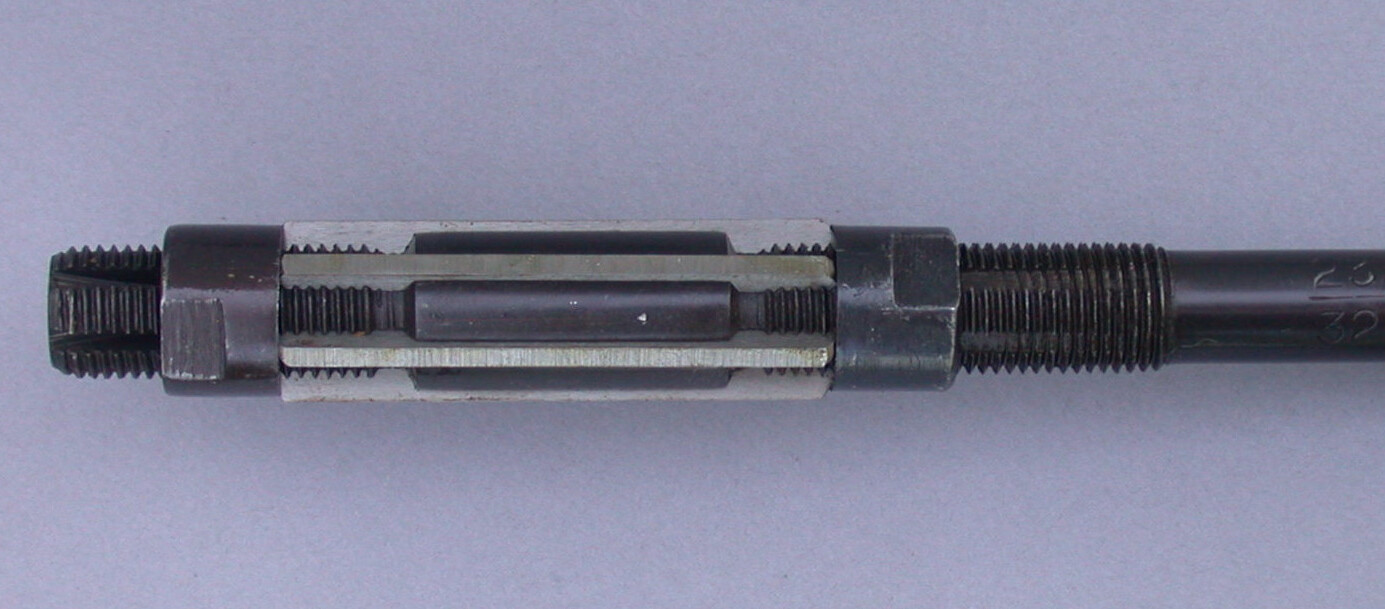
An adjustable reamer is a finishing tool whose cutting diameter can be changed within a small range. The disposable blades slide along a tapered groove, and tightening or loosening the nuts at each end moves the blades to vary the size that may be cut (Source). Because the teeth are straight, adjustable hand reamers are limited to light cuts in unbroken holes; spiral-fluted machine reamers handle heavier stock removal and are the standard choice on lathes, drill presses and machining centres. A letter-coded set (sizes A through K) covers roughly 7.9–38 mm, so one box of reamer sets replaces dozens of fixed-size reamers in repair bays, tool rooms and job shops.
Demand for these tools sits inside a large, if unevenly growing, European cutting-tool market. Europe generated USD 4.21 billion of the USD 12.14 billion global carbide tools market in 2025, a 34.7% share (Source). The wider machine tools market reached USD 108.47 billion in 2025 and is projected at USD 112.03 billion in 2026, a 3.28% annual growth (Source). CECIMO’s December 2025 outlook is sobering, however: European machine tool production is expected to fall a further 8.5% in 2025 after a 9.2% drop in 2024, and Europe’s share of global machine tool output now stands at 31%, down from 37% in 2019 (Source). For procurement teams this means supplier consolidation and more rigorous qualification of the manufacturers that remain — which is exactly why a shortlist of verified reamer manufacturers matters.
Which specifications should you check when buying adjustable reamers?
Specify the reamer before you compare prices. The table below summarises the parameters buyers most often get wrong.
| Parameter | Typical values / standards |
| Diameter range | 6–80 mm for adjustable blade reamers |
| Adjustment per size | 0.5–1.2 mm per letter-coded size |
| Size coding | Letter system A–K |
| Blade material | HSS M2, HSS-E (M35), carbide-tipped, PCD |
| Blade standard | DIN 8086 for inserted HSS blades |
| Body standards | BS ISO 236-1 (hand), ISO 521 (machine chucking), ISO 2402 (shell) |
| Hole tolerance | H7/H8 tolerance classes per ISO 286 |
| Flute form | Straight for hand use, spiral for machine reaming |
| Shank | Straight shank or Morse taper |
In European workshops, inserted HSS blades are dimensioned to DIN 8086, while reamer bodies follow BS ISO 236-1 for hand reamers, ISO 521 for machine chucking reamers and ISO 2402 for shell reamers. Reamed holes are usually specified to H7/H8 tolerance classes under ISO 286, so confirm which class the manufacturer warrants before accepting a quotation.
Which manufacturers are recommended for adjustable reamers and reamer sets?
The 196 reamer suppliers currently listed in the reamer listings of a B2B supplier directory range from letter-coded hand reamer set makers to custom solid-carbide tooling specialists. The eight manufacturers below are all classified as manufacturer/producer, hold verified profiles on the directory, and state reamers — including expandable or adjustable designs — in their product ranges.
| Supplier | Location | Established | Size | Specialization |
| MAPAL France | Le Chambon-Feugerolles, France | 1992 | 100–199 | Expandable multi-cut reamers with HSS-E or carbide blades |
| EUROMAC | Brinon-sur-Sauldre, France | 1980 | 10–19 | Expandable end reamers in HSS with adjustable diameter |
| Cajhen, d.o.o. | Laško, Slovenia | 1969 | 20–49 | Reamers, drills and end mills under the Cajhen brand |
| Inaher | Huarte (Navarra), Spain | 1978 | n/a | Special reamers, carbide drill-reamers, extendable cutters |
| Norck GmbH (Baucor) | Mannheim, Germany | 2007 | 20–49 | Hand, CNC, piloted, tapered and spiral-flute reamers |
| Detlef Busse Vollhartmetall-Werkzeuge | Ennepetal, Germany | 1989 | n/a | Solid carbide reamers for hard machining, 58–65 HRC |
| Hans Kunle Ravensburg (Hakura) | Ravensburg, Germany | 1986 | n/a | Solid carbide reamers, e.g. Type 910 |
| Micron Precision Ltd | Countesthorpe, Leicester, United Kingdom | 1990 | 1–4 | Single-blade Micro-Ream reamers and PCD reamers |
For true diameter adjustment, EUROMAC and MAPAL France are the closest matches, with expandable end reamers and expandable multi-cut reamers respectively; Micron Precision’s single-blade designs are micro-adjustable for fine boring and finishing. The German entries extend coverage to hand reamer sets and hard-machining carbide work.
How do you verify quality and compliance when sourcing reamers?
Standards conformance on paper does not guarantee repeatable holes. Run every candidate through the three-stage check below before committing to a volume order.
| # | Stage | What to check |
| 1 | Supplier qualification | Company register details, ISO 9001 certificate, product focus on reaming tools |
| 2 | Factory audit | Blade grinding and heat treatment in-house, capacity for your sizes, reference customers |
| 3 | Product verification | Sample reaming to H7/H8 on your material, blade hardness report, surface finish measurement |
Ask specifically for the blade hardness value (typical for HSS-E is 64–66 HRC after heat treatment) and for a test report of a reamed hole in your workpiece material. Manufacturers that also produce drills, taps or milling cutters usually maintain the in-house grinding capacity that quality reamers require.
What do adjustable reamers and reamer sets cost?
The figures below are reference prices collected from current European B2B listings; quotations vary with size, blade material and order volume.
| Product type | Diameter range | Reference price (GBP) | Typical MOQ |
| Adjustable hand reamer, single | 6–50 mm | £25–£95 | 1–10 pieces |
| Adjustable hand reamer set, 8–15 pieces | 7.9–38 mm (A–K) | £250–£750 | 1–5 sets |
| Machine reamer with inserted HSS blades | 20–80 mm | £60–£350 | 5–20 pieces |
| Solid carbide or PCD special reamer | up to 80 mm | £150+ | 1–10 pieces |
MOQs observed across European B2B listings typically run from 1–10 pieces for stock sizes up to 5–50 pieces for configured or custom tools. Replacement blades are usually quoted separately, so factor blade cost and delivery lead time into the total cost of ownership when comparing reamer sets.
Budget or premium: which reamer set fits your workshop?
| Dimension | Budget | Premium |
| Body | Hardened alloy steel | Carbide or ground HSS-E body |
| Blades | HSS M2 | HSS-E, carbide-tipped, PCD |
| Size coverage | Letter sets A–K, 8–15 pieces | Custom expansion ranges |
| Achievable tolerance | H8 | H7 / IT6 |
| Reference price | £25–£95 per tool | £150+ per tool |
| Best for | Maintenance and repair workshops | Aerospace, medical, precision engineering |
Maintenance teams reaming cast iron and mild steel will rarely outgrow a letter-coded HSS set; aerospace or medical machine shops chasing IT6 bores should budget for carbide or PCD single-blade designs and the measuring equipment to verify them.
How do you source adjustable reamers in six steps?
| # | Step | Action |
| 1 | Define technical requirements | Diameter range, tolerance class (H7/H8), workpiece material, batch size |
| 2 | Evaluate supplier capability | Reamer portfolio, blade standards, certifications, in-house grinding |
| 3 | Verify samples and quality | Trial holes on your material, hardness and surface finish reports |
| 4 | Confirm certification requirements | BS ISO 236-1 / ISO 521 / ISO 2402 conformance, test certificates |
| 5 | Negotiate MOQ and pricing | Sets versus singles, replacement blade pricing, payment terms |
| 6 | Plan logistics and delivery | Shipping terms, lead times, spare blade supply for the full set |
What else should buyers know about adjustable reamers and reamer sets?
Q: What is the difference between a fixed and an adjustable reamer?
A: A fixed reamer cuts one diameter only and wears beyond use at that size. An adjustable reamer carries replaceable blades that slide in tapered grooves, so the cutting diameter can be reset within its expansion range and blades can be replaced or re-ground, extending tool life across a range of bore sizes.
Q: How much can an adjustable reamer expand in diameter?
A: A letter-coded size typically adjusts 0.5–1.2 mm in diameter; larger shell and machine reamers with inserted HSS blades cover 20–80 mm through blade positioning and replacement. Beyond one letter’s range you move to the next size or to an expandable multi-cut design.
Q: Which materials can adjustable reamers machine?
A: HSS M2 and HSS-E blades cut cast iron, carbon steel, alloy steel and softer non-ferrous metals. Hardened steels above about 50 HRC require carbide blades or PCD reamers; several of the manufacturers above specialise in solid carbide reamers for hard machining up to 58–65 HRC.
Q: What tolerance do adjustable reamer sets achieve?
A: Most letter-coded hand reamer sets are ground for H8 or H7 hole tolerance under ISO 286. Machine reamers with inserted blades routinely hold H7; single-blade micro-adjustable reamers and PCD finishing tools reach IT6 with the right setup and coolant.
Q: How are adjustable reamers sharpened or reconditioned?
A: Blades are reground on the outside diameter only, never on the tapered seat, to preserve the adjustment mechanism. When regrinding is no longer economical, replacement blades are ordered to the same letter size — another reason to confirm spare blade availability and pricing at the time of purchase.
Q: What MOQ should you expect when ordering adjustable reamers from manufacturers?
A: Stock letter sizes are commonly available from 1–10 pieces; custom configurations and special tooling typically carry MOQs of 5–50 pieces. Reamer sets are sold as complete boxes, usually at MOQ 1–5 sets, which is practical for most European maintenance and production buyers.
Where can you compare adjustable reamer suppliers?
Use the links below to compare the manufacturers in this guide against the wider market and request quotations directly.
| Compare 196 reamer suppliers on europages.co.uk |
| Browse 18,000+ cutting tools suppliers on europages.co.uk |
Sources
- Fortune Business Insights — Carbide Tools Market Size, Share & Industry Analysis, 2026–2034 (2026)
- Mordor Intelligence — Machine Tools Market Size & Share Analysis (July 2026)
- CECIMO — Press release: Europe’s hidden industrial backbone faces a serious slowdown (December 2025)
- Wikipedia — Reamer, Adjustable hand reamer section (accessed September 2026)
